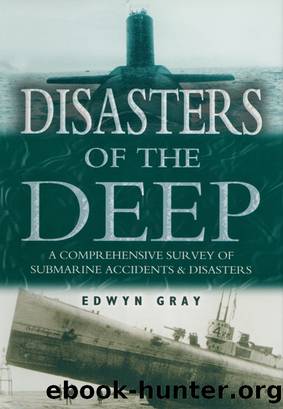
Disasters of the Deep by Edwyn Gray
Author:Edwyn Gray
Language: eng
Format: epub
Publisher: Pen and Sword
Published: 2003-08-14T16:00:00+00:00
NINE
‘Hi, fellas. Here we are.’
(USS Squalus)
I was just before one o’clock when the telephone rang on Charles Momsen’s desk in the Experimental Diving Unit at the Washington Navy Yard. The Lieutenant-Commander picked up the handpiece.
‘Momsen speaking.’
‘Swede – this is Lockwood.* The Squalus is down off Portsmouth. We need your help.’
‘How deep?’
‘We don’t know for sure – but I guess somewhere between 200 and 400 feet. She went down near the Isle of Shoals. We’re laying on a plane for you. There’ll be room for three more. You have a free hand to take who you want.’
Momsen put the telephone down and leaned forward across the desk. He flicked the switch of his intercom.
‘Tell Lieutenants Yarbrough and Behnke to get the hell over here fast. And find McDonald. We’ll be leaving from the Anacostia Air Station in less than an hour. This is an emergency!’
* * *
Squalus left her overnight moorings in the Piscatagua River at 7.30 am on 23 May, 1939, and headed out into the Atlantic to continue her programme of diving trials. The submarine was brand new. Built at the Portsmouth Navy Yard, she had only been commissioned in March and, after ironing out various minor faults, she had tasted the salt water of the sea for the first time on 12 May.
A member of the Sargo class of Fleet submarines, officially designated as the New S class 2nd Group, she displaced 1,460 tons and measured 310½ feet from stem to stern, only 28 feet less than the British K-class. She was armed with eight 21-inch torpedo tubes plus a deck-mounted 4-inch gun for surface action. On the morning she set off from Piscatagua River on her last voyage she carried a team of five officers, headed by her skipper Lieutenant Oliver Naquin, fifty-one regular crewmen, and three civilians.
Grey clouds were building up on the seaward horizon as Squalus plunged her bows into the rolling Atlantic swell and the large white 192 prominently painted on both sides of her conning-tower gleamed each time the early morning sun peeked through the darkening banks of cumulus. The wind was freshening and flecks of spray whipped from the cresting waves as the falling barometer presaged the approach of a deep low pressure area. But the submarine was riding well and Naquin had no qualms about her sea-worthiness. Built for war, she moved purposefully through the water at a full 16 knots – the acrid smoke from her 5500 hp General Motors diesel units trailing astern from the exhaust trunks like the black pennants of a jousting knight.
At 8.13 am Naquin made a preliminary signal to the Portsmouth Navy Yard detailing the precise location and duration of the first dive. Below in the control room the submarine’s Executive Officer, Lieutenant Walter Doyle Jr, began the usual routine safety checks that were always carried out on a new boat before submerging. Just before 8.40 he made his report to Naquin.
‘Rigged for diving, sir.’
High up on the conning-tower bridge the Captain acknowledged Doyle’s report and ordered full emergency power from the engines.
Download
This site does not store any files on its server. We only index and link to content provided by other sites. Please contact the content providers to delete copyright contents if any and email us, we'll remove relevant links or contents immediately.
Whiskies Galore by Ian Buxton(42143)
Introduction to Aircraft Design (Cambridge Aerospace Series) by John P. Fielding(33240)
Small Unmanned Fixed-wing Aircraft Design by Andrew J. Keane Andras Sobester James P. Scanlan & András Sóbester & James P. Scanlan(32867)
Aircraft Design of WWII: A Sketchbook by Lockheed Aircraft Corporation(32380)
Craft Beer for the Homebrewer by Michael Agnew(18339)
Turbulence by E. J. Noyes(8188)
The Complete Stick Figure Physics Tutorials by Allen Sarah(7471)
The Institute by Stephen King(7144)
The Thirst by Nesbo Jo(7087)
Kaplan MCAT General Chemistry Review by Kaplan(7044)
Bad Blood by John Carreyrou(6720)
Modelling of Convective Heat and Mass Transfer in Rotating Flows by Igor V. Shevchuk(6527)
Weapons of Math Destruction by Cathy O'Neil(6454)
Learning SQL by Alan Beaulieu(6395)
Man-made Catastrophes and Risk Information Concealment by Dmitry Chernov & Didier Sornette(6200)
Permanent Record by Edward Snowden(5945)
Digital Minimalism by Cal Newport;(5909)
Life 3.0: Being Human in the Age of Artificial Intelligence by Tegmark Max(5677)
iGen by Jean M. Twenge(5500)
